The Complete Wide Plank Flooring Guide for Specifiers
The Complete Wide Plank Flooring Guide for Specifiers
Wide plank flooring has become the defining look of contemporary premium interiors — from converted lofts in Berlin to boutique hotels in Dubai. But for buyers and specifiers, wide planks are also the most technically demanding format in wood flooring: the wider the board, the more its construction, grade and moisture control matter. Specify it well and it is the most impressive floor in your portfolio; specify it casually and it is the first floor to show movement complaints. This guide covers everything a specifier needs: what counts as wide plank, how it is built, which specifications actually decide performance, and what to confirm before placing a bulk order.
What Is Wide Plank Flooring?
Definitions vary by market, but the working consensus is straightforward: wide plank flooring starts where standard boards end. Standard planks typically run 120–180 mm wide; wide plank begins around 190–200 mm and extends beyond 300 mm. Lengths matter too — premium wide plank programs combine wide boards with long lengths, often 1800–2200 mm, which is what creates the calm, uninterrupted look designers are paying for.
| Format | Typical Width | Typical Length | Visual Effect |
|---|---|---|---|
| Standard plank | 120–180 mm | 1200–1800 mm | Traditional rhythm, many joints |
| Wide plank | 190–260 mm | 1800–2200 mm | Modern, calm, fewer joints |
| Extra-wide plank | 260–320 mm+ | 2000–2400 mm | Statement floor, showcase spaces |
Why Wide Plank Is an Engineered Product
Here is the technical fact that shapes every decision in this guide: wide planks are engineered by necessity. Solid wood moves across its width with humidity, and a 300 mm solid board would simply move too much for reliable use. Wide plank flooring is therefore built as a sandwich — a genuine sawn hardwood wear layer on top, bonded to a cross-ply core whose alternating grain directions lock the plank against movement.
This is not a compromise; it is the technology that makes the format possible. A well-built engineered wide plank is more stable than any solid equivalent, works over concrete subfloors and underfloor heating, and still looks, feels and refinishes like solid wood. When you evaluate suppliers, the construction of the core — ply count, adhesive quality, pressing control — is where wide plank quality is actually decided.
The Specification Checklist: What Decides Performance
Wide plank amplifies every construction variable. These are the fields that belong in your purchase order, with typical premium values:
| Spec Field | Recommended Range | Why It Matters |
|---|---|---|
| Total thickness | 14–20 mm | Thicker boards resist telegraphing and suit glue-down over heating |
| Wear layer | 3–4 mm sawn veneer | Allows 2–3 refinishing cycles; the main cost driver |
| Core | Multi-layer cross-ply, minimum 9–11 plies for wide formats | More plies = better stability across 260 mm+ widths |
| Grade | Defined against a written A–F chart | Wide boards show every knot — grade control is more visible |
| Joint / profile | Click or T&G, precision-milled | Wide boards need tight joints to avoid gapping lines |
| Moisture content | Matched to destination climate (e.g. 7–9% for Europe) | Wrong moisture is the root cause of most complaints |
| Finish | UV lacquer or hardwax oil, brushed surface | Wide surface area magnifies wear patterns and gloss variance |
Two fields deserve emphasis. Wear layer: wide planks are a premium investment, and a 3–4 mm sawn wear layer protects that investment with decades of refinishing capacity. Grade: a knot that reads as rustic charm on a 150 mm board can dominate a 300 mm board — agree the grade chart in writing (AMUER's A–F system is published precisely for this) before comparing prices.
Where Wide Planks Win — and Where They Don't
Best-fit applications
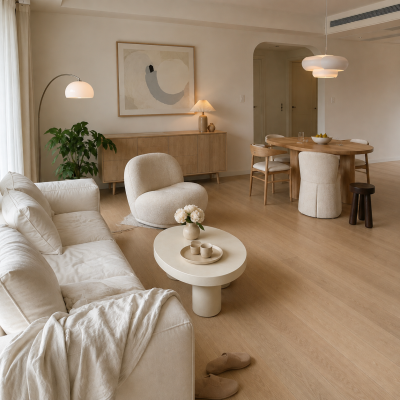
- Lofts and open-plan living. Fewer joints mean calmer visual planes across large areas — the core aesthetic appeal of wide plank.
- Hotel lobbies and showrooms. Wide boards photograph beautifully and read as luxury in first-impression spaces.
- Premium residential developments. Wide plank oak is now the default expectation in high-end apartment marketing.
- Spaces with underfloor heating. Engineered wide plank over modern heating systems is the signature combination of Northern European design.
Use with care
- Small rooms. Very wide boards can overwhelm compact spaces; 190–220 mm is usually the better proportion.
- Wet rooms and entrances without mats. Water exposure is the enemy of any wood floor, and wide boards show local swelling more prominently.
- Budget-driven volume projects. Wide plank consumes more premium raw material per square meter; where cost rules, a long plank format delivers a similar modern feel at a lower price.
Common Pitfalls in Wide Plank Projects
- Skipping acclimatization. Wide boards need adequate site conditioning before installation; boxes opened and laid the same day in a humid building is the classic complaint generator.
- Underestimating waste factor. Long, wide boards mean fewer, larger pieces — plan 8–10% cutting waste and confirm mixed batch lengths with the supplier.
- Mixing batches without color check. Order the full quantity in one production run, or verify tone compatibility between batches with real samples before installation.
- Buying on price alone. A wide plank quote can be "cheapened" invisibly — thinner wear layer, fewer core plies, vague grading. Compare the checklist above line by line, not just the total.
Working with a Factory That Specializes in Wide Plank
Wide plank rewards manufacturing depth. At AMUER, wide plank is produced in engineered construction up to 320 mm widths and 2400 mm lengths, with sawn wear layers from 3 mm, the full A–F grade range, and OEM finishes from brushed UV lacquer to smoked hardwax oil. Because production is duplicated across our Dalian and Serbia factories, large orders can be split across two supply points — and the Serbia in-stock program covers common wide plank references for fast European delivery.
Frequently Asked Questions
Q1: What width counts as wide plank flooring?
Most markets consider 190–200 mm and above as wide plank, with extra-wide starting around 260 mm. Standard planks run 120–180 mm. Confirm the exact widths offered when comparing suppliers, as definitions vary.
Q2: Is wide plank flooring more expensive?
Yes, typically. Wide boards require premium raw material — long, defect-free sections of timber — so expect a premium over standard formats in the same species and grade. The look, however, is precisely what premium projects are buying.
Q3: Is wide plank flooring stable?
In engineered construction, yes — that is the point. The cross-ply core limits movement far better than solid wood, which is why virtually all serious wide plank programs are engineered. Check core ply count and adhesive quality when evaluating suppliers.
Q4: Can wide plank flooring be installed over underfloor heating?
Yes — engineered wide plank is compatible with most modern radiant systems. Confirm the product's heating approval and maximum surface temperature, and follow the supplier's commissioning schedule when starting the system.
Q5: Does wide plank flooring show scratches more?
Wide boards show wear patterns more prominently because each board has a larger surface area. A matte or brushed finish, and a quality lacquer or oil system, greatly reduce visible scratching — specify finish quality alongside grade.
Q6: Can wide planks be combined with herringbone or chevron in one project?
Yes, and it is a popular design move — wide plank in living areas, matching herringbone in entry zones, all from the same oak supply and grade system. Just confirm both formats come from one factory so tone and finish match exactly.
See the Wide Plank Collection
Browse AMUER wide plank flooring — up to 320 mm widths and 2400 mm lengths, across the full A–F grade range, engineered for stability over concrete and heating systems.
Explore the Wide Plank Collection →Request wide plank samples and the full specification sheet. Physical boards in your chosen widths and grades, plus construction details — wear layer, core, moisture standard — for your project documentation.
Request Samples & Specification →